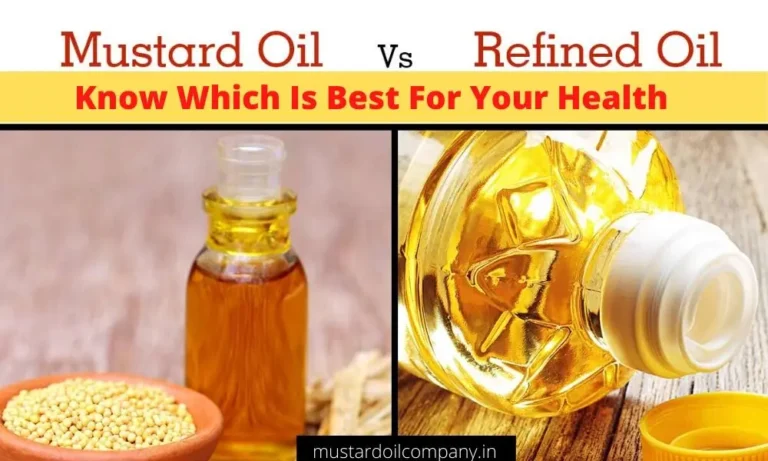
Walk down any oil aisle and you'll find a dozen bottles, each claiming to be the healthiest choice on the shelf. So which is actually true — and how do you tell a genuinely good oil from a cleverly marketed one? It helps to understand how the two main categories, refined oil and traditional cold-pressed mustard oil, are actually made.
What counts as "refined oil"?
Refined oils are extracted from a wide range of plant sources — seeds, nuts, legumes, and fruits. Soybean, corn, sunflower, peanut and olive oils are some of the most common examples found in Indian kitchens today, alongside many others.
How refined oil is made
Refined oil starts as a natural plant extract, but it doesn't stay that way for long. It's treated with chemical solvents — commonly hexane — to pull oil from the raw material, then heated to very high temperatures to strip out odour, colour, and flavour. That's part of why refined oils taste so neutral: the processing removes most of what made the original ingredient distinctive in the first place.
It's also worth noting that "cholesterol-free" claims on these bottles can be misleading. Most refined oils still contain a mix of saturated and unsaturated fats, and saturated fat intake is one of the factors linked to higher blood cholesterol and cardiac risk.
Where refining can go wrong for your health
Chemical exposure
Solvents like hexane, used during extraction, can affect the liver, lungs, and skin with repeated exposure.
Preservatives
Added to extend shelf life, these compounds bring their own long-term health concerns.
Digestive strain
Trace sodium hydroxide, used in processing, can be hard on the digestive system over time.
Bleaching agents
Used to deodorise and lighten the oil's colour — another chemical step with its own risks.
High-heat damage
Intense heat during refining destroys natural nutrients and can generate free radicals linked to disease.
What is mustard oil?
Mustard oil — known across India as sarson ka tel — is also a plant-derived oil, pressed from clean, sound mustard seed. It's been the everyday cooking oil in states like Punjab, Haryana, Madhya Pradesh, Uttar Pradesh, Rajasthan, Bihar, West Bengal and several others for generations. India happens to be the world's fourth-largest oilseed producer, with mustard playing a major role in that.
Kachchi ghani: the old way of pressing oil
Kachchi ghani is the traditional cold-press method for extracting oil from seed — historically done in a kolhu, a wooden press once turned with the help of a bullock. Because the seeds are crushed at low temperature rather than treated with heat or chemicals, the oil keeps its natural antioxidants, essential oils, and aroma compound (allyl isothiocyanate) intact — which is where much of its health value comes from.
Why mustard oil holds up well by comparison
Digestive stimulant
Encourages bile and gastric juice production, aiding digestion and circulation.
Natural appetiser
Used in cooking, it can help stimulate appetite.
Antibacterial
Helps fight infection internally and when applied to the skin.
Insect repellent
Its scent naturally keeps insects away — used in traditional vaporisers.
Antifungal
Allyl isothiocyanate content helps inhibit fungal growth.
Hair nourishment
Linoleic and oleic acids nourish the scalp and may slow premature greying.
Joint relief
Anti-inflammatory properties ease arthritis and rheumatic pain with regular massage.
Skin health
Vitamins A, B-complex and E support anti-aging and protect against UV damage.
It's also been used traditionally for everyday complaints — colds, coughs, body aches, congestion, headaches and even asthma relief — along with dental care, where a mix with salt and turmeric is used to strengthen gums. Research has also pointed to mustard oil's linolenic acid converting into omega-3 fatty acids that may help guard against colon and stomach cancers.
The bottom line
Once you understand what each oil goes through before it reaches your kitchen, the choice becomes a lot clearer. Refined oil trades flavour and nutrition for a longer shelf life and a neutral taste. Kachchi ghani mustard oil keeps its pungency, its nutrients, and its centuries-old place in Indian cooking — without a single chemical step in between.
Looking for genuine kachchi ghani mustard oil?
Kisan Brand presses ours the same traditional way — no refining, no shortcuts.
Ask us on WhatsApp